Flipspark is the first game I made with the Godot engine, and the most relaxing one to make so far. After False Door, with its hundred riddles and a voice-over that took a while to get right, I wanted something light: a puzzle you can pick up for two minutes or two hours, with no story you have to follow. That was the plan. Today it has 42 pages of story and a shadow that marks my work out of ten, so something clearly went off script.
Why Godot
The games before this one were built with Apple's SpriteKit, which is lovely, but it only speaks iPhone. I'd wanted to try Godot for a while. It's free, it's open source, and it promised an easy path to an Android version without rewriting everything. Flipspark was the test.
Something very common, with a twist
For a first try, I wanted something very common on the App Store rather than something clever. So I let an AI agent do the homework on the idea: read the puzzle charts and suggest a concept that works in portrait on an iPhone, with a name to match. My rules were short. Quick sessions that can also go on for longer, a daily challenge, and a title starting with F. Fart Me To The Moon, False Door, and technically Avery's Forest Adventure too: it was Forest Friends Adventure until my younger son wanted his name on it. At this point it's a house style.
The suggestion was Lights Out with a twist. Tap a tile and it flips along with its four neighbours. Fill a whole row or column with light and it ignites. Clear two lines at once and you score four times as much; three lines, nine times.
The rest I added on purpose. A totally unnecessary backstory with three magic schools: the houses of the Lantern Academy, called Inkwell, Tumblewick and Nightbloom, each with its own powers. And a target nobody sensible would set: a thousand islands to restore. It's almost impossible to finish, which is exactly the point. You can play as much as you like, and there's always another island.
Playable from the first evening
The very first commit was already a game: a 5×5 board, three rooms with their own twist on the flip, a daily board that's the same for everyone, a short tutorial and a smiling orange star as a mascot. Unlike my other games, there was never a long stretch where nothing worked, so every change could be judged by simply playing it.

The first big fix was a funny one. When a line ignited, the board refilled in the same instant, so the one moment the whole game is about happened where nobody could see it. Now the line gets its moment to shine.
Finding the look
To work out the look, I tried three art directions as concept sheets, a bit like flicking through a catalogue before you buy a sofa. Coloured light on a dark plum background won. From there came the icon, Folded Light: a spark folded from a peach plane and a lilac one, with a diagonal seam between them, a little nod to flipping. The star lost its smile on the way, and the project notes say, very firmly, not to bring it back.

The game also needed somewhere to go. The Paper Archipelago won that round: origami islands floating on a plum-dark sea, joined by glowing bridges. That's where the thousand islands come from, and later the name on the store.

Most of Flipspark is drawn by Godot in code: the board, the tiles, the menus and every spark, shockwave and DOUBLE!. The paper islands, the icon and the logo started out as generated art, and Godot does the rest, arranging the islands into an archipelago, colouring each chapter and lighting the bridges between them. Turns out you can do origami without touching any paper.
Colour-blind galore
A game about tiles lighting up is, it turns out, a game about telling colours apart. I'm colourblind (the False Door story has the long version), so from the start I wanted to enjoy this one without squinting. Flipspark has a high-contrast mode with a colour-blind-safe palette, and the automated tests check its contrast ratios, so the computer argues about shades instead of me.
Sounds, but no voices
The 38 sound effects are 31 made with ElevenLabs and 7 made by small scripts, picked one evening by ear. The tap has three variations, so it doesn't click the same way twenty times per run. The music is 13 tracks made with Suno, with titles like A Minor Inconvenience to Physics and Moonpaper Lullaby.
What there isn't, on purpose, is a voice. False Door's narrator took me a while to get right, line by line, and I didn't want to do that again so soon. Flipspark talks to you with small animated cards and big stamps that say DOUBLE!, TRIPLE! and UNREAL!, and for a long time that was plenty.
Playtesting, mostly with myself
The first thing I did after restoring island 2 was share my score... with myself, on WhatsApp, right under a Fart Me To The Moon score asking "Can you beat my fart?". The message had no link to the game, which rather defeats the point. In Italian, the leaderboard tabs had been squeezed into columns one syllable wide. And the word "school" meant two different things on the same screen, which is how the three schools became the houses of the Lantern Academy.

The nastiest bug turned up when the game was tested like a complete newcomer would play it. Lose island 4, watch an ad for three extra flips, win... and the game refuses to save. You watch an ad, you win, and you lose the island anyway. Fixed the same day.
Free, with a few ads
The first version had a "Remove ads" purchase. It went two weeks in. A game you dip into for a few minutes didn't make sense behind a paywall, so Flipspark is free, with an ad once in a while. The ads that give you something, like three extra flips, are always your choice, and the others are capped so you're never flooded.
My son likes it, and I keep playing it myself, quite often, which for a game I've tested to death is the best review I can give it.
Two stores, two stories
Apple's first answer was a rejection under guideline 4.3(a), the spam rule: too similar to other apps. My theory was the engine. Every Godot game ships almost the same engine program, so on paper Flipspark looked like every other Godot game out there. So Flipspark got its own build of Godot, compiled without 3D, physics, VR and everything else the game never uses: 111 MB instead of 189, and very much its own binary.
Android is the part Godot promised, and it delivered: from a design document in the morning to a signed Google Play bundle by the evening, with ads, sharing, achievements and a Back button that Godot delivers twice per press, because of course it does. Google wants a closed test with twelve testers for fourteen days before anyone else can download it. Flipspark passed, and went out on Google Play.

The second no
Then Apple answered again. Same rule, same rejection. All that work had given me a lovely small binary and changed nothing at all. In the meantime Fire, Gees & Braai! had gone through review on the ordinary Godot engine, so the binary was never the problem.
Apple doesn't tell you what would change its mind, so this next part is only my reading of it. Remember the homework at the start? I'd asked for something very common on the App Store, and that's exactly what I'd got. From the outside, Flipspark was one more square board of flipping tiles, and everything that made it different turned up several islands in, long after a busy reviewer had seen enough.
So I stopped changing the paperwork and changed the game.
The dark fights back
A puzzle board doesn't want anything from you. It just sits there and waits. So the first job was to give the game an opponent: a shadow that lands on one of your lit tiles and, every third flip, strikes and puts it out, unless you light a line through it and drive it off. It has angry eyes. It was the first thing in the game that ever looked back at me.
Then the square had to go. There are now 36 island shapes, with gaps, coasts and cliffs, and a gap counts as lit, so each shape asks for different lines. Your character and your first power come right at the start, the new tricks begin on island 2, and all 1,000 islands were rebalanced to suit.


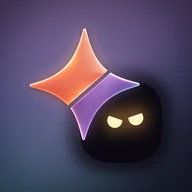
The icon changed with it. The folded spark stayed, and the dark came up behind it, with the same eyes as the shadow in the game. The tagline went from "One bright idea. A thousand little islands." to "One spark against the dark."

Every tile has two sides
Once something was looking back at you, it seemed rude not to let it talk. That totally unnecessary backstory from the first week turned out to be necessary after all, and the idea had been sitting in the rules since the first commit: every tile has two sides. So does the world.
All 40 chapters now have a name instead of a number, and your atlas has 42 pages to keep. On the front of each one, Vesper, the last lamplighter still awake, writes to you in the margin. She's warm, she fusses, and she tells you to keep your tiles lit and, whatever you do, not to turn the page. You turn the page. Something on the back gives your flipping six out of ten, and it has a few questions.


That's all you're getting from me. It turns out to be very hard to write a making-of about a story you can't spoil.
One old rule survived: it still isn't a story you have to follow. A page is one tap to pass, it never interrupts a board, and it doesn't change the islands, the rules or your score. If you were already far along when the update arrived, you keep everything, and the pages you missed are waiting in the atlas.
I worked the story out with AI, the way I do with most of my design notes these days, and it's in the same six languages as the game. There's still no voice, only writing. After False Door, I'm happy for it to stay that way.


The easy one, mostly
From the first commit to version 1.0 took 38 days. It wasn't effortless: there was a rejection, a rebuilt engine and an ad bug that stole islands. But it was playable from the first evening, it never fought me, and I enjoyed almost every step. It's still one of the easiest games I've made, and one of the ones I play the most.
Then again, maybe that was the trouble. It took two rejections to work out that a game that never fights anyone could do with a fight. Now it strikes every third flip and has opinions about my homework, and I like it better for it. The iPhone version went back to Apple with all of this inside it, and this time the answer was yes. Flipspark is out on the App Store and Google Play.

The home screen on day one said "No rush. No lives. Just one more bright idea." Today it says "No rush. Just one more bright idea." There are still no lives. The line just got shorter.