In 2004 I kept score at a netball tournament. I had never heard of netball. Twenty-two years later, I made a game about it.
I was living in London and had just started dating the South African woman who would become my wife. One weekend I was invited along to an amateur tournament at a school: teams of expats from Australia, New Zealand and South Africa, taking it very seriously. They were short of scorekeepers, so they handed the score sheet to the one person in the hall who had never seen the sport before. An Italian. I learned fast.
Fast forward to 2026, and a school run. My wife works at our kids' school, so she usually brings them home, but that afternoon she was stuck in a meeting and it was my turn. While I waited, the school netball team, girls a year or two older than my eldest, were moaning that the boys had FIFA (or FC, or whatever it's called now) and there was no game for them. That stayed with me for a while.
Then I was playing Sensible World of Soccer again, in a browser this time. It's still one of my favourite football games ever, and I started to wonder which other sports could have that feeling: an arcade game for a quick session on your phone, with a proper sim underneath. I didn't have to wonder for long. Netball had found me twice now, at a tournament in London and at the school gate, so one day I just started.
The management side was the easy part. I'm a Football Manager fanatic, and to me a glorified sports spreadsheet is the best thing there is. So I built 20 nations. Netball is a very Commonwealth sport, but just because I can, I added a few with zero netball history, like Italy and Poland or the USA for the americans out there. The match itself was the hard part. For a long time it was too frenetic, too random and too chaotic, and it took a while before it was fun on my own iPhone. This is the story of getting there, although I still like the SIM side a lot.
Netball, for the rest of us
In 2004 I needed a crash course before I could keep score. Here's the one I'd have liked:
- Seven a side. Each player wears a bib with her position: GS, GA, WA, C, WD, GD and GK.
- Everyone has her zones. The court is split into thirds, and each position may only go into some of them. A Goal Keeper never crosses halfway.
- No running with the ball. Catch it, land, and pass it within three seconds. No dribbling, and no walking with it.
- Only two players can score. The Goal Shooter and the Goal Attack, from inside the circle, into a ring with no backboard.
- Defend from a distance. Stand closer than about a metre to the player with the ball and it's obstruction. Touch her and it's contact.
It's fast, it's tactical, and it's mostly passing. On paper, that makes a perfect arcade game. On paper.
Five weeks, in one list
- Day one. My notes, a first match on an Android phone, the pixel-art athletes, the first sounds and themes, and a logo and icon marathon that ran into the evening.
- Day two. The Pro League menus, Club Career, real national flags, the sound board and four rounds of virtual playtests.
- Day three. Three commentary booths, the Daily Challenge, the website and the server behind it.
- Day six. Notes from the first real players: bigger controls, a marker on your player, a calmer speed. Edit Teams, and the first TestFlight builds.
- Day fifteen. Version 1.0 goes to App Review, with an upright split view for the iPad and the iPhone Duo.
- Day eighteen. The Android closed test starts.
- Day twenty-two. Match Day and the match centre: sim the match and steer it from the touchline.
- Day twenty-three. The match gets rebuilt so you can follow it: the whole court, pass lines, tap a teammate to pass.
- Day thirty-three. Chain passes, catch fire. A new trailer, new screenshots, and version 1.0.2.
A game from 1995 that kept going
My notes opened with one line I kept coming back to: Fast Seven Netball "should feel like a brilliant sports game from 1995 that somehow kept being developed for another thirty years." Sensible Soccer and NHL 95 on the outside: pixel art, a landscape phone, quick matches. Underneath, the things those games never had: real rules taught as you play, tournaments, a club career, commentary.
The notes had 8 nations. The game has 20, with 12 players each, every one of them fictional. That's 240 netballers who don't exist, which still makes them easier to manage than a real squad.
On day one there was a match on an Android phone with tiny players, a close camera on bare wood, and two buttons that said PASS and LOB. The title screen said "v0.1.0 · VERTICAL SLICE", which is a polite way of saying "please don't look too closely".


From 21 pixels to 42
The first players were drawn by code: 21 pixels tall, readable if you squinted. That morning I tried PixelLab, an image generator that only makes pixel art. After a style test and a pilot, its netballer was twice as tall, had a ponytail and a proper bib, and actually looked like she was about to catch something. By the evening PixelLab's players were the default.
Then came the library: six hair types (ponytail, afro, puffs, bun, crop and braids), 14 hair colours and 8 skin tones, with 19 animations drawn in five directions and mirrored to eight. Height and build are drawn by the game itself, so a tall Goal Shooter and a compact Centre come from the same sprite. It wasn't all smooth. On day six real players told me they could see "pixels jumping", so the animations got steadied.


The 20 nations got real flags, their own kits and a style of play each. The clubs in the career got crests, mixed by the game from 8 shapes and 18 emblems. There are 9 venues, from an outdoor park court to a night arena with a crowd that roars for the home side. The two pixel fonts are the game's own, drawn letter by letter.
"It looks like she is dunking"
A netball logo has one job: not to look like basketball. The ring has no backboard, the shooter doesn't fly at it, and nobody, ever, dunks.
I started from my own concept sheets, made with ChatGPT, and spent most of day one on rounds of logos. My notes from that afternoon are short. "That 7 is too big." "None of 3 convinces me." On a polished vector roundel: "not happy". Then: "Seven-Star Crest is the winner logo, just maybe make a better shape than the shield, also when scaled the stars are awful." In the end, the logo that stuck was a PixelLab netballer at the top of a set shot, zoomed in on her head, her hands, the ball and the ring.
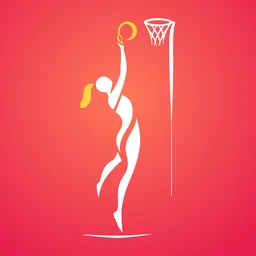
The app icon went the same way. A flowing pictogram in rainbow colours came close, and my verdict was: "MUCH better! the icon is great, but it looks like she is dunking." She was. One more round and she was standing tall, ball above her head, in a proper set shot: a white figure on coral, the icon on the phone today.


Five testers who don't exist
On day two the game met its first players, all five of them invented. Each one was a persona with a name, an age, a phone and opinions. They played through the real game and wrote up what they found. Linda, 54, plays casually on an old iPhone SE. Grace, 27, plays Goal Attack for a club in Manchester. Tom, 41, is a netball dad. Priya, 38, has more than a thousand hours of Football Manager. Jayden, 17, plays basketball at school.
They were blunt. Linda opened the settings and found: "Pass assist? Floating stick? PixelLab? ElevenLabs? I just wanted bigger writing." Grace caught my commentary calling a goal "Nothing but net", "Swish" and a "long-range bomb": "that's basketball." Priya broke my transfer market in one season: "I signed her for nothing in pre-season and sold her for 165k at week nine. That's not management, that's a money printer." But Grace also said the line I wanted to hear: "Zones, three seconds, a penalty pass with the defender standing out beside the thrower... whoever built this has played netball." I haven't, Grace. I kept score once.
Four rounds took the score from 3.4 to 4.7 out of 5, and by the last one Linda wrote: "Oh, that's lovely: the little netballer shoots, it goes in, and FAST SEVEN bangs up. It looks like a proper game now." Hold on to that 4.7. It comes back later.
Three booths and a crowd
Sports games live or die by their sound. There are 57 sound effects from ElevenLabs, each one picked by ear on a sound board: trainers squeaking on wood and on the outdoor court, footsteps, the whistle, and a different crowd for each kind of venue. My note on the goal sound was clear: "give a few variations of goal, too boring the same one."
The commentary came on day three: three booths with two commentators each, voices designed with ElevenLabs, and 678 lines between them. The first voices were all men, so I asked: "let's add some variety, maybe a female commentator as well?" Some of the first takes ran their sentences together without a breath, so those were recorded again.
The music is three themes from Suno, for the menus, the tournaments and the finals, made on the paid plan so they can ship in a game. During a match there's no music at all, just the crowd and the commentary. That's how a real match sounds.
Too frenetic, too random, too chaotic
The five testers loved it. Then real people played it, and so did I, properly, on my own iPhone. My notes from that week aren't pretty: "Start of the game. Got the ball trying to pass. No idea where. Lost it. They score in 3 passes. Then I can't defend. And so on. No idea what happens on the screen." And from a first-time player: "I got the ball but everything happened too quickly. My pass was always wrong… I would not even understand where my team was located."
So why did my virtual testers give it 4.7? Because in the matches they played through a bot, and the bot always knows the best pass. A real thumb doesn't.
The goal I wrote down was the Sensible Soccer feeling: "imagine playing Sensible Soccer the first time, you may lose, but you feel like you were in control." Version 1.0 was already waiting at Apple. The match got rebuilt anyway:
- The whole court on screen. All fourteen players, post to post, held still. A camera button steps through four views if you want to get closer.
- Pass lines. While you hold the ball, a trail of dots runs to every teammate: green is safe, amber is risky, red can be cut out.
- Tap a teammate to pass to her. No more aiming the stick at a moving target.
- Time to think. On the easier levels the match slows down while you hold the ball.
- Defending you can do. The computer looks at her target before she passes, and a pale band shows where you can win the ball.


Chain passes. Catch fire.
It was "definitely much better". I could finally play a match. But my next note was the honest one: "once in the action the players are not getting any reward for their actions on the screen." Netball is mostly passing, so the reward had to be passing too. "I like your chain idea but we need to implement it properly."
- One cue at a time. There's always exactly one thing on screen telling you what to do next: the pass to make, the shot to take or the spot to stand on.
- The chain. Every pass that gains ground adds a link, and the links widen your shot. Chain eight and your catcher is ON FIRE.
- QUICK HANDS and ON THE LEAD. Tap the next teammate while the ball is still in the air, or hit a player sprinting into space, for a bonus link.
- READ THE PASS. JUMP. Run at the ball and your defender stops at arm's length with her arms up, so running at her isn't a foul any more. A ring closes where you can meet the pass: JUMP as it closes, and gold means you can reach it.
Or just manage
And for the FM fanatic in me, and in you, there's the other half. Club Career starts you on a park court with a club you create, and climbs three divisions to the arena, one 20-week season at a time: sign players, set your tactics and train your squad. For the nations there are four tournaments, from the Nations Cup to the World Championship, with groups, knockouts and a medal ceremony.
If you don't feel like playing the match, don't. Pick your seven, set your plan, then sim it and steer it from the touchline: changes, tactics and live stats, while the same match engine plays it out in front of you. I still play it that way a lot. Edit Teams lets you rename any player, nation or club and change how they look, and it's free for everyone.
Speaking of free: there are no ads and no tracking. Quick Match, the Daily Challenge, Edit Teams, the Nations Cup group stage and the first ten weeks of Club Career cost nothing. One purchase, the Full Game, unlocks every tournament and the whole career, for good.
Approved, and held back
Version 1.0 went to Apple on day fifteen. It had a party trick for the iPad and Apple's new foldable, the iPhone Duo: stand the iPad up, or half-fold the Duo on a table, and the match splits in two, with the court on top and your controls, a live formation map and the team stats below. Apple approved it. I still didn't release it. On some iPhones the picture was cut off at the edge, and the iPad had black bars. A fixed build went back for review, and while it waited, the first real players were telling me the matches were frantic.
So version 1.0 never went out. Version 1.0.2, with the whole court, the pass lines and the chain, is the one that shipped. On Android, a closed test came first, as Google asks of new developers: a group of testers played it for two weeks before it could go public. It's out now on Google Play and, since 21 November, on the App Store too.
By the numbers
- 20 nations and 240 fictional players. The plan was 8.
- 7 positions, each kept to her own zones.
- 4 tournaments, and a club career of 24 clubs in 3 divisions.
- 9 venues, from a park court to a night arena.
- 6 hair types, 14 hair colours and 8 skin tones.
- 3 commentary booths, 6 commentators and 678 lines.
- 57 sound effects and 3 music themes.
- 4 camera views, and 4 levels from Rookie to World Class.
- 5 virtual testers, 4 rounds, and 1 bot that always knew the best pass.
- 0 dunks. Not in the game, and not on the icon any more.
What I learned
- Keep score at a tournament in a sport you've never heard of. Twenty-two years later, it might become a game.
- When the school netball team says there's no game for them, believe them.
- A test that plays through a bot tests the bot. Hand the phone to a real person.
- "You may lose, but you feel in control" is a design brief, not a slogan.
- If your netball icon looks like a dunk, it's a basketball icon.
- Reward the thing the sport is about. In netball, that's the pass.
- Approved isn't the same as ready.
Final whistle
I still can't tell you who won that tournament in 2004. I was too busy getting the scores right. This time, keeping score is the game's job, and the ball is in your hands. Three seconds, then pass it.